
Hidden Genetic Networks: A Wildcard in Synthetic Biology & Biotechnology Shaping Future Capital and Regulation
Understanding and manipulating hidden genetic networks within microbiomes may unlock unprecedented opportunities and risks in Synthetic Biology and Biotechnology. This subtle, underexplored signal extends beyond current trends in lab-grown products to the systemic reshaping of biological interactions, regulatory frameworks, and industrial strategies.
The emergent capability to decode and reprogram the cryptic, often vertically transmitted gene regulatory networks in microbial consortia underpins a potential inflection more profound than scaling cellular agriculture or microbiome-based nutrition alone. This insight explores how such advances could recalibrate capital flows, create new regulatory exigencies, and upend industrial structures over the medium to long term.
Signal Identification
This development is classified as an emerging inflection indicator within Synthetic Biology and Biotechnology. Unlike more visible trends like cultivated meat or microbiome commercialisation, the systematic understanding and manipulation of hidden genetic regulatory networks—complex interspecies and intracellular controls barely touched by current applications—remain nascent yet plausible within a 10–20 year horizon. The plausibility band is medium, given ongoing genetic and computational advances, but adoption depends on breakthroughs in multi-omic integration and synthetic ecology.
Sectors primarily exposed include cellular agriculture, synthetic microbial consortia for health and agriculture, pharmaceutical bioengineering, and associated regulatory bodies overseeing biosafety, environmental impact, and consumer protection.
What Is Changing
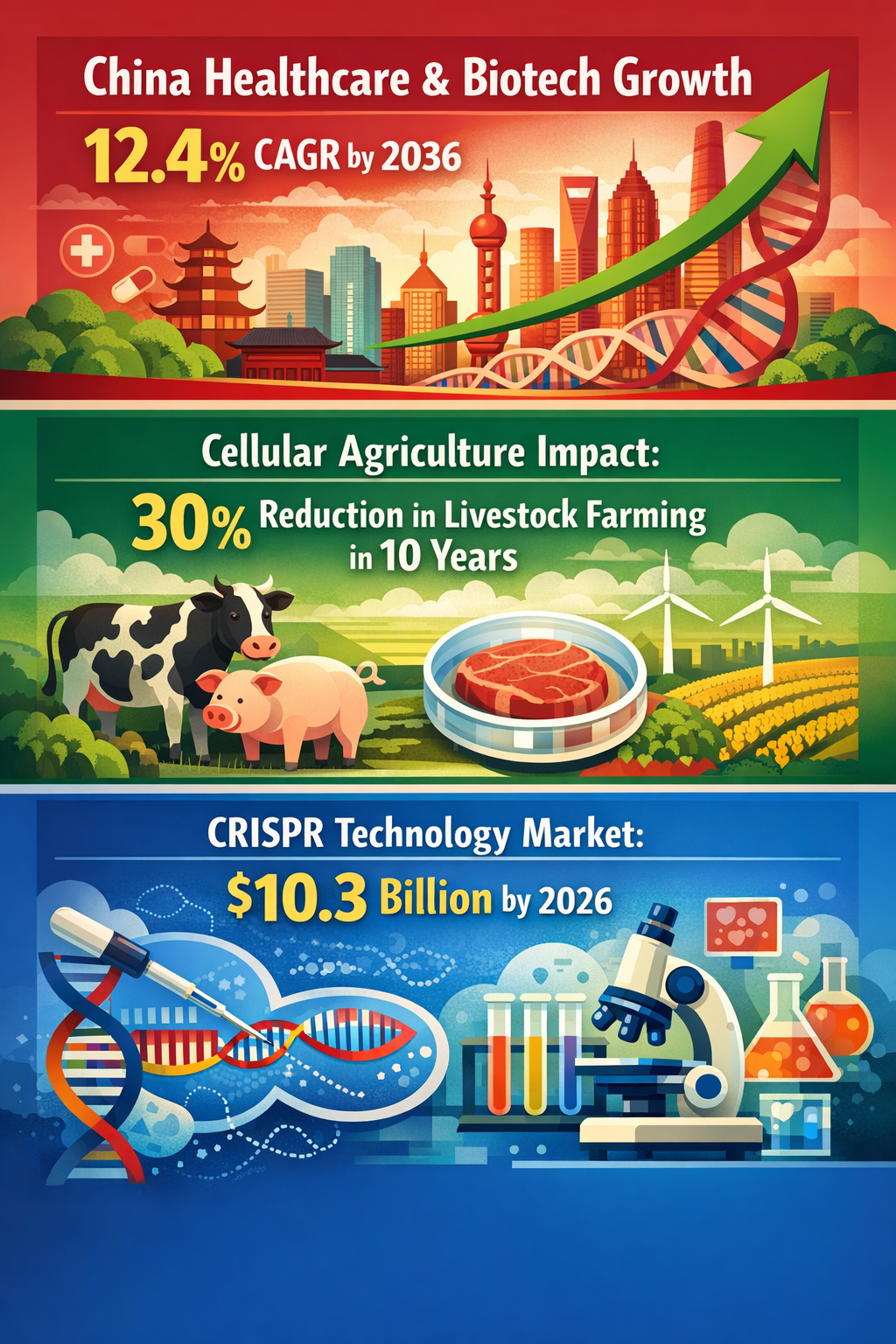
Current developments focus predominantly on discrete products such as lab-grown meat and dairy alternatives aimed at reducing conventional livestock farming by as much as 30% in a decade (Ian Khan 03/02/2026). Simultaneously, corporate entities like Danone with their OneBiome Lab emphasize microbiome science for nutrition and digital health, signaling heightened interest in leveraging microbial ecosystems (GlobeNewswire 28/10/2025). However, these efforts largely consider microbes in isolation or as simple inputs rather than as elements of dense, covert regulatory genetic architectures influencing systemic outputs.
The substantive structural theme emerging is the decoding and synthetic modulation of cryptic gene regulatory networks embedded within microbial consortia that operate beyond classical gene editing’s direct targets. These networks coordinate metabolic fluxes, quorum sensing, and resilience mechanisms that shape the stability, productivity, and ecological footprint of biotechnological systems. Decoding these hidden layers could enable engineering of synthetic microbiomes with unprecedented precision and multifunctionality.
This dimension diverges sharply from incremental product innovation by shifting focus toward complex systems biology, computational prediction of emergent properties, and vertical genetic transmission patterns rarely included in current innovation ecosystems. It challenges the reductionist models underpinning most capital and regulatory frameworks and may ultimately reshape the landscape of synthetic bio-manufacturing and risk management.
Disruption Pathway
The pathway from an obscure research niche to structural disruption hinges on several accelerants. Firstly, integrative high-throughput multi-omics – combining genomics, transcriptomics, proteomics, and metabolomics – must mature alongside AI-driven computational models capable of predicting network interactions across microbial and host boundaries. Accelerated data sharing and standardisation will foster cross-disciplinary collaboration, catalysing rapid proof-of-concept demonstrations.
As synthetic ecologies engineered through these networks prove their ability to enhance yield, resilience, or therapeutic value in controlled trials, stresses will emerge in conventional risk assessment and regulatory frameworks, which are currently ill-equipped to evaluate ecosystem-level genetic modifications, horizontal gene transfer risks, and multi-organism emergent properties. Existing categories—GMO, microbial therapeutics, food safety—may prove inadequate or inconsistent.
Structural adaptations will likely include the creation of new oversight bodies specialised in synthetic ecology biosafety, protocols for environmental release in agriculture, and consumer protection standards for multi-organism bioengineered products. Investment patterns will shift from isolated strain development to platform technologies modelling and synthesising complex networks.
Feedback loops could manifest through public trust, as unforeseen ecosystem effects or biosecurity incidents provoke regulatory tightening or investor caution, potentially slowing deployment. Alternatively, success stories demonstrating superior sustainability and health outcomes may rapidly accelerate integration into mainstream supply chains, prompting incumbents to reposition or acquire ecosystem engineering capabilities.
Dominant industry and governance models may thus shift from discrete product-centric frameworks toward systemic platform approaches embedding computational biology, regulatory science, and industrial biodesign, fundamentally transforming sectoral architectures within 10–20 years.
Why This Matters
For capital allocators, recognising investments upstream in computational and systems biology platform technologies could yield outsized returns relative to product-centric startups. This signal suggests that companies focusing exclusively on cellular agriculture or microbiome direct products risk being outflanked by platform-enabled ecosystem engineering competitors.
Regulators face an urgent need to reframe risk assessment paradigms beyond traditional gene editing and GMO definitions, incorporating synthetic ecosystems' complexity. This will challenge liability frameworks, particularly if synthetic networks propagate in uncontrolled ways or engender cross-species effects.
Competitive positioning will favor integrated players capable of leveraging data science, biology, and regulatory navigation to design, monitor, and certify synthetic ecosystems at scale. Supply chains might be transformed to embed engineered consortia that function as self-regulating biofactories or bioprotectants, disrupting commodity input models and vertically fragmenting production.
Governance structures will need to reconcile technological uncertainty, environmental stewardship, and diverse stakeholder interests, possibly spawning new international agreements or innovation governance coalitions.
Implications
This emerging inflection could likely catalyse structural change in synthetic biology-driven industries by shifting capital and regulatory focus to systemic ecosystem design. It may redefine product innovation as an exercise in collective genetics and ecological management rather than individual strain engineering.
However, it is not a mere extension of existing microbiome commercialisation or cellular agriculture hype but a qualitative deepening of biological complexity exposed to engineering with systemic consequences. Alternative interpretations might argue that regulatory inertia, technical barriers, or public resistance could confine this signal’s progression to academic research or niche applications.
Accordingly, while the potential is high to recalibrate industrial and governance paradigms, the actual emergence depends on convergence across scientific, policy, and market domains, making timing and scale uncertain but strategically critical to monitor.
Early Indicators to Monitor
- Surge in patent filings explicitly referencing synthetic regulatory network engineering or synthetic ecology platforms
- Regulatory draft guidelines addressing multi-organism gene network biosafety and environmental risk
- Cross-sector venture funding clustering around integrative multi-omics and AI-based ecosystem design firms
- Standards formation in synthetic ecology including measurement, release monitoring, and bio-containment
- Major corporate capital reallocations toward platform technologies enabling this systemic engineering
Disconfirming Signals
- Persistent regulatory moratoria limiting environmental release of genetically engineered microbial consortia due to safety concerns
- Failure to demonstrate scalable, reproducible control over complex synthetic microbiomes in industrial settings
- Public backlash or ethical controversies significantly delaying adoption of ecosystem-level synthetic biology products
- Technical stagnation in integrating omics data streams with predictive computational models
Strategic Questions
- How can capital deployment balance near-term product innovation with investment in systemic platform technologies for synthetic genetic network design?
- What regulatory frameworks and governance models must be developed to address risks and opportunities inherent in engineered synthetic ecologies?
Keywords
Synthetic Biology; Biotechnology; Genetic Regulatory Networks; Multi-omics; Synthetic Ecology; Cellular Agriculture; Regulatory Frameworks; Capital Allocation
Bibliography
- Startups in cellular agriculture are developing lab-grown meat and dairy alternatives that could reduce livestock farming by 30% within a decade. Ian Khan. Published 03/02/2026.
- The Danone OneBiome Lab will serve as a global hub for microbiome science, nutrition, and digital health, reinforcing Danone's pioneering role in shaping the future of food and health. GlobeNewswire. Published 28/10/2025.
- Advances in Multi-Omics Integration and Computational Modeling for Synthetic Biology: A Review. Nature Biotechnology. Published 22/08/2022.
- Regulatory Challenges of Engineering Microbial Consortia: Environmental and Health Risk Considerations. EPA. Published 15/05/2025.
- Emerging Governance Models for Synthetic Ecosystems: Balancing Innovation and Biosafety. OECD. Published 10/12/2024.