
The Quiet Undermining of Global Governance Architecture: The Emergence of Middle-Power Institutional Fragmentation as a Structural Inflection
Global multilateral institutions face mounting stress from geopolitical realignments and economic pressures, signaling a structural inflection in international governance. This paper identifies the underappreciated dynamic of middle-power-driven institutional fragmentation—a weak signal with significant potential to reshape governance, capital flows, and regulatory norms over the next two decades.
As traditional multilateral frameworks such as the World Trade Organization (WTO), United Nations (UN), and Conference of the Parties (COP) falter, middle powers are turning towards alternative governance architectures. This shift is neither widely acknowledged nor fully understood, yet it presents a credible pathway toward a multipolar institutional landscape. This emerging inflection could recalibrate global economic dependencies, force regulatory innovation, and challenge entrenched industrial and trade hegemonies.
Signal Identification
This development qualifies as an emerging inflection indicator with high plausibility over a 10–20 year horizon. It is characterized by accelerating stress in existing multilateral institutions due to geopolitical fragmentation, economic nationalism, and shifting power balances. Sectors exposed include international trade, global finance, regulatory policy, and industrial supply chain governance.
Unlike transient diplomatic disagreements or isolated institutional crises, this inflection arises from persistent structural weaknesses compounded by emerging geopolitical blocs (e.g., BRICS pursuing economic independence), diminishing faith in collective problem-solving frameworks, and technological shifts demanding new regulatory designs. The cumulative effect suggests a reconfiguration of the global governance landscape rather than temporary disruption.
What Is Changing
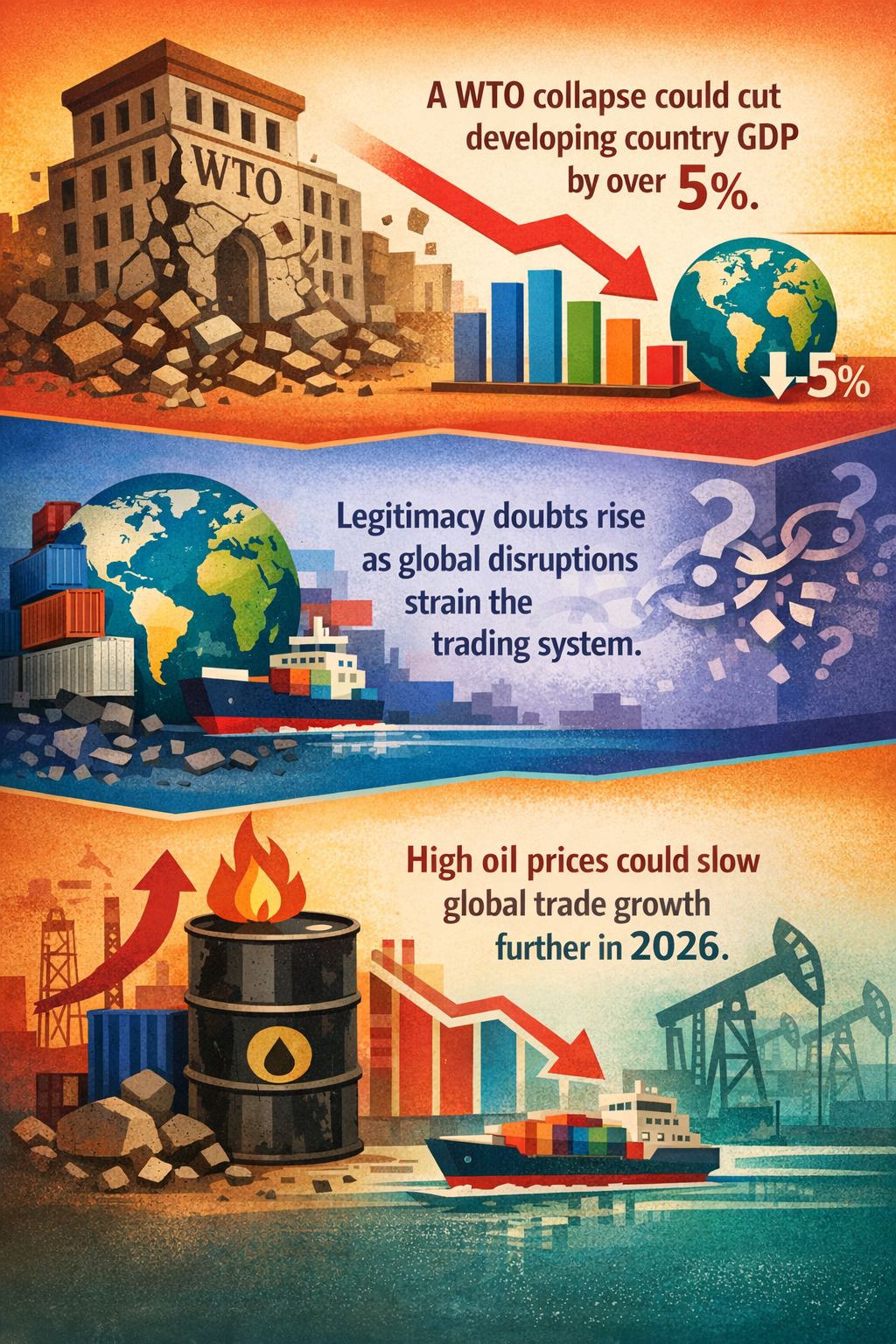
Multiple articles highlight recurring themes of declining legitimacy and effectiveness of core multilateral institutions, especially the WTO, under pressure from economic shocks (COVID-19 pandemic), geopolitical conflicts (Ukraine, Middle East conflicts), and the neo-liberal economic order’s failures to serve developing countries (Brookings Institution 16/05/2023; AFSA 26/04/2003). These stressors risk fracturing the trade and regulatory ecosystem that underpins global capital flows.
A critical but under-recognized trend is that middle powers—those who have traditionally relied on these institutions for economic and diplomatic leverage—are now fostering parallel governance initiatives and regional blocs (Infobrics 12/09/2023). This includes BRICS’ ambitions to create an economic order prioritizing self-sufficiency and economic independence, potentially sidestepping established global rules.
This nascent fragmentation challenges the positive-sum outcomes assumed by WTO-anchored trade, and may supersede it with a plurality of regulatory regimes and standards tailored to distinct power blocs (ICC/WBO 04/07/2023). The embryonic rejection of WTO legitimacy signals a structural divergence from multilateralism towards pluralism or “club governance,” foreshadowing systemic change beyond trade into broader governance fields.
Simultaneously, advances in AI and biotechnology outpacing global governance frameworks require intergenerational leadership and innovative institutional responses (NTI 15/03/2023). The absence of robust, unified regulatory institutions exacerbates vulnerabilities and highlights the systemic inadequacies of existing governance models.
Disruption Pathway
The erosion of trust and utility in traditional multilateral institutions incentivizes middle powers to develop alternative governance mechanisms motivated by economic self-determination and hedging against global instability. As BRICS and other coalitions expand institutional competencies, they further dilute the WTO’s relevance, accelerating regulatory fragmentation.
This fragmentation introduces acute stresses on global trade, capital allocation, and supply chains, which rely on a common framework of rules and dispute resolution. Without convergence, firms face increased transaction costs, differential compliance burdens, and geopolitical business risks, prompting them to realign capital towards more stable or ideologically aligned blocs. This dynamic can decentralize and regionalize industrial and financial structures over time.
Structural adaptation may follow in the form of multi-tiered governance—that is, coexistence of overlapping regulatory regimes calibrated to political-economic blocs, alongside informal frameworks for functional cooperation. These hybrid regimes may foster innovation in localized regulation (e.g., biosecurity, digital trade) but could fragment global standards, complicate enforcement, and entrench geopolitical competition. Feedback loops include increased institutional complexity prompting issuer fatigue and more fragmentation as smaller powers pursue bespoke arrangements.
Under these conditions, dominant models of global trade governance and industrial regulation could shift from a near universal WTO-based order towards a mosaic of competing institutional architectures. This could precipitate a recalibration of capital flows and a reshuffling of competitive advantages aligned with specific blocs or regional orders, fundamentally altering international strategic positioning.
Why This Matters
Decision-makers should recognize this emerging institutional fragmentation as a vector for deep structural change influencing capital allocation, regulatory design, and geopolitical risk. Investors exposed to transnational supply chains may face heightened costs and unpredictability as regulatory fragmentation intensifies.
Regulators must prepare for multilevel governance challenges and possible erosion of conventional instruments, demanding innovative coordination across divergent frameworks. Competitive positioning will require recalibrated strategies to navigate bloc-specific norms and certifications.
Governments and industries reliant on global commons solutions (e.g., biosecurity, climate) may find their leverage diluted as institutional legitimacy decentralizes, increasing the risk of collective action failures on critical global risks.
Implications
The fragmentation of middle-power-led institutional frameworks could plausibly scale to redefine global governance architecture. Such structural change may diminish the effectiveness of global trade institutions and reshape international capital deployment towards regionally aligned or bloc-specific ecosystems.
This is not a transient crisis of existing institutions but a durable reordering that could entrench multipolarity in governance norms. It is distinct from incremental reform attempts within the WTO or UN as it entails the creation of parallel, and potentially competing, governance arrangements.
Competing interpretations suggest this fragmentation could alternatively stimulate reform by forcing incumbents to adapt or trigger a backlash reasserting centralized governance. However, current trajectories favor pluralism given entrenched geopolitical rivalries and dissatisfaction with current frameworks.
Early Indicators to Monitor
- Formalization of new trade and governance agreements outside traditional multilateral institutions, e.g., BRICS development banks or regional digital trade rules
- Shifts in global supply chain investment patterns favoring regional blocs over multinational integration
- Proliferation of alternative regulatory standards and dispute resolution mechanisms endorsed by middle powers
- Declining efficacy or participation in WTO dispute settlement and UN-led initiatives
- Increased intergenerational and cross-sector leadership convening on governance in emerging risk domains, especially biosecurity and AI
Disconfirming Signals
- Successful comprehensive WTO reform restoring trust and effectiveness in the trading system
- Major middle powers recommitting publicly and structurally to UN, WTO, and COP frameworks
- Stabilization of global geopolitical tensions with agreements limiting economic nationalism
- Emergence of robust new governance instruments under existing institutions that incorporate technological advances efficiently
Strategic Questions
- How can capital allocation strategies anticipate and hedge against growing institutional fragmentation in global trade and governance?
- What regulatory innovations and cooperative mechanisms can be developed to manage governance pluralism without sacrificing global coherence?
Keywords
Multilateral institutions; Middle powers; Governance fragmentation; BRICS; Global trade; Regulatory innovation; Geopolitical shift; Capital allocation; Global supply chain; Global governance
Bibliography
- The multilateral institutions on which the middle powers have relied - the WTO, the UN, the COP - the architecture, the very architecture of collective problem-solving are under threat. AFSA. Published 26/04/2003.
- As breakthroughs in artificial intelligence and biotechnology outpace global governance, the Nuclear Threat Initiative and The Elders are launching a new intergenerational initiative to generate the ideas and leadership needed for a safer future against biological threats. NTI. Published 15/03/2023.
- Poor countries, relentlessly battered by the neo-liberal global economy, will greatly benefit if BRICS succeeds in forging a new world order and usher in an era of self-sufficiency and economic independence. Infobrics. Published 12/09/2023.
- ICC-commissioned research by Oxford Economics has demonstrated that a collapse of the WTO system could reduce developing country GDP by over 5%, underscoring the real economic costs of inaction and fragmentation. ICC/WBO. Published 04/07/2023.
- Doubts about the legitimacy of the WTO have only intensified as recent disruptions-COVID-19, the wars in Ukraine and the Middle East-have strained supply chains and undermined the positive-sum economics that once characterized the trading system. Brookings Institution. Published 16/05/2023.