
The Latent Weaponization of Civilian Urban Infrastructure Through Autonomous Drone Swarms
Emerging autonomous drone swarm technologies, combined with evolving private military contractor (PMC) roles and urban infrastructure vulnerabilities, suggest an under-recognized pathway to the weaponization of civilian spaces. This latent signal foreshadows a structural shift in urban security, capital deployment, and regulatory priorities over the next two decades.
Current discourse on weaponization largely focuses on overt military technologies or cyber warfare, but a weak yet growing shift is underway where civilian urban environments become inadvertent battlefields through scalable, low-cost, autonomous drone swarms operated by private entities. This transforms traditional defense paradigms and demands reconsideration of both industrial strategy and regulatory frameworks in critical infrastructure protection.
Signal Identification
This development qualifies as a weak signal with high plausibility over a 10–20 year horizon, marked by incremental technological maturation and evolving conflict dynamics. It emerges from the convergence of autonomous drone swarm tactics, the privatization of lethal force, and urban operational complexity in America’s and NATO’s theaters (Drone Warfare Insights 16/03/2026; Turdef 06/03/2026). The signal is weak because it is overshadowed by headline military AI and cyber escalation narratives yet critical as it exposes a non-intuitive front for urban and industrial defense sectors, law enforcement, and regulatory agencies.
Key exposed sectors include urban infrastructure management, security technology providers, defense contracting (especially PMCs), insurance and liability governance, and urban regulatory frameworks, all of which face novel systemic risks and investment needs.
What Is Changing
Multiple articles reveal that urban drone warfare operations by US-licensed private military contractors are causing civilian casualties and civilian infrastructure disruptions at scales which may provoke reconsideration of existing export licensing and operational oversight (Drone Warfare Insights 16/03/2026). This intersection of privatized lethal capability with urban environments is structurally new, as military operations traditionally separated combat zones and civilian areas by geography and legal frameworks.
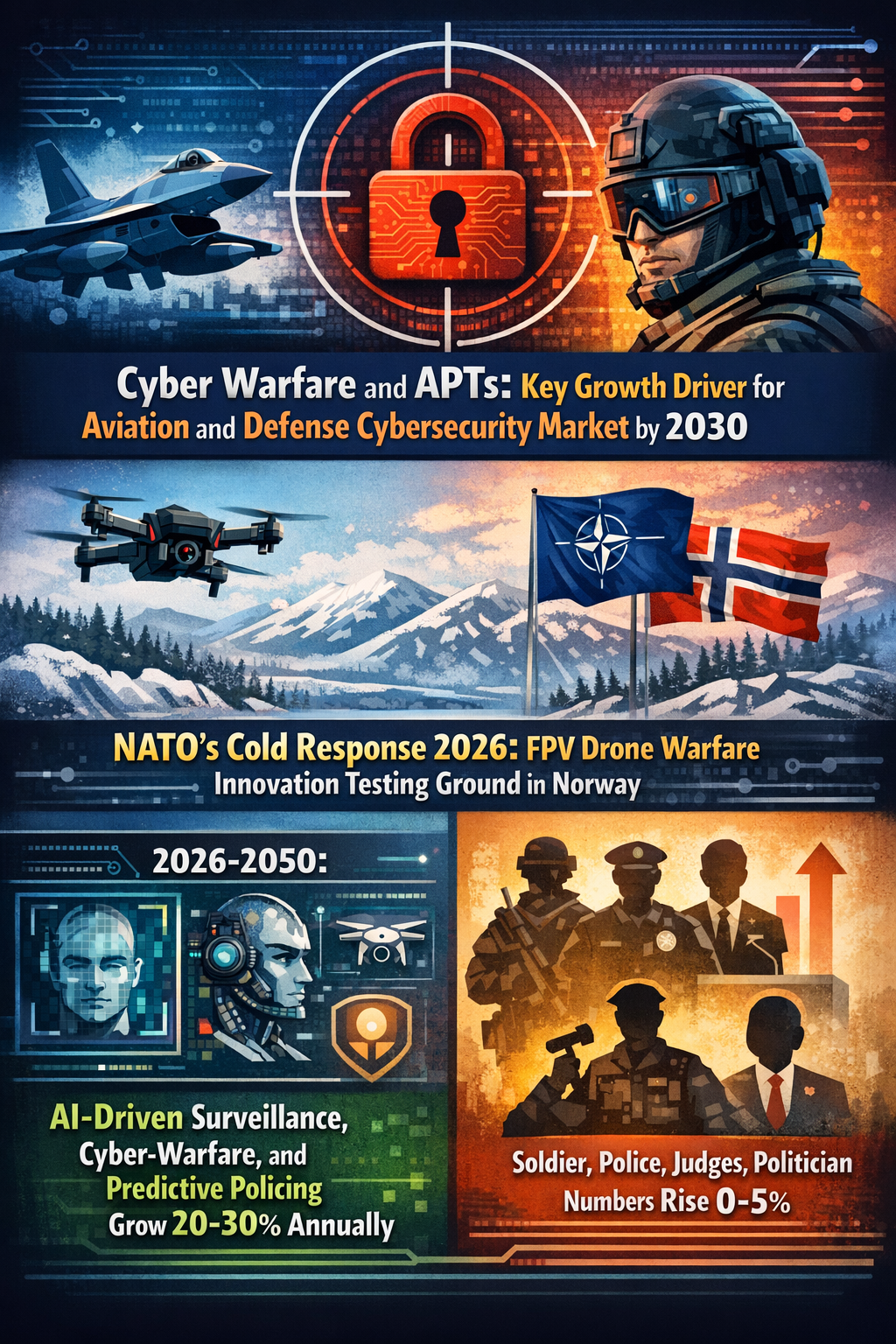
NATO’s Cold Response 2026 exercise demonstrated focused experimentation with first-person view drone warfare in complex, constrained environments (Turdef 06/03/2026) reflecting operational scenarios transferable to urban civilian zones. The exercise’s attention to FPV (first-person view) drone swarms indicates attempts to refine tactics in environments reminiscent of cityscapes with restricted maneuver zones and dense civilian object presence.
Additionally, drone swarm attacks targeting energy infrastructure and critical transit hubs in the Middle East illustrate the scalability and low-cost nature of these methods, thus exposing physical infrastructure vulnerabilities to persistent and economically asymmetric disruption (Mackinder Forum 06/03/2026). Traditional air defense systems, typically designed for conventional munitions, struggle to keep pace with low-cost drones, forcing costly and often ineffective issuerations.
The regulatory environment is struggling to adapt. UN negotiations on military AI and autonomous weapon systems have yet to grasp the granularity of hybrid warfare realities where state and non-state actors blur roles, and offensive capabilities proliferate among PMCs (Council on Foreign Relations 02/03/2026). This disconnect raises the risk of regulatory lag and ineffective governance, particularly in the licensing of lethal drone services and export controls.
Disruption Pathway
The trajectory toward structural change begins with accelerating autonomous drone swarm proliferation in urban environments, driven by tactical success in conflicts such as Ukraine, and the growing reliance on private military contractors who operate in legal and operational grey zones. As demonstrated in recent US and NATO exercises, these operators leverage scalable, low-cost assets that can penetrate urban defenses, threatening civilian infrastructure, commercial assets, and public safety (Drone Warfare Insights 16/03/2026; Turdef 06/03/2026).
Such conditions stress existing defense systems, which were architected around kinetic air defense and cyber network disruptions but are ill-prepared for persistent, decentralized drone swarm threats. The rising costs of interceptors and complexity of scalable urban defense also burden municipal and national budgets. These fiscal and technical stresses incentivize strategic shifts towards autonomous, AI-driven countermeasures and an increased role for private security actors, possibly privatizing what has historically been public defense functions (Mackinder Forum 06/03/2026).
This cascade likely induces regulatory adaptation cycles focusing on real-time export and operational licensing regimes, tighter restrictions on PMC battlefield roles, and urban drone airspace governance. Feedback loops arise as rising drone swarm capabilities prompt corresponding innovation in counter-swarms, raising escalation dynamics in urban conflict spaces (Council on Foreign Relations 02/03/2026).
Should these dynamics continue, dominant urban security and defense industries may fragment and reorganize, integrating AI-driven predictive policing, automated airspace control, and decentralized command-to-drone systems, disrupting existing defense industrial bases and regulatory paradigms (MECI Group 10/03/2026).
Why This Matters
For senior decision-makers, this emerging weaponization vector could reshape capital flows toward novel defense technologies emphasizing AI-driven counter-drone systems, urban security infrastructure, and resilient physical asset design. Industrial strategy will need to accommodate new forms of urban “combat readiness” and cross-sector collaborations between defense, law enforcement, and private security entities.
Regulatory frameworks risk lagging behind if they continue focusing narrowly on state-centric military AI controls while failing to account for the politicized and decentralized nature of PMC-enabled urban drone warfare. This could lead to gaps in legal oversight, liability exposure, and risk governance for civilian casualties and collateral damage.
Strategically, first-mover advantage may accrue to states and firms developing scalable, autonomous, low-footprint countermeasures and integrated command architectures for urban drone incident management. Supply chains linked to sensor tech, AI processing, and low-cost aerial platforms might see re-rating, disrupting incumbents tied to legacy air defense systems.
Implications
This latent weaponization signal could plausibly scale into a structural reshaping of urban security ecosystems and redefine the interface between civilian infrastructure and military-grade autonomous systems. It might prompt preventive capital deployment towards urban-resilient infrastructure and adaptive regulation of lethal AI-enabled technologies beyond traditional state controls.
However, it is not a sudden revolution but rather an incremental inflection weaving together technological innovation, privatization of force, and urban vulnerability. The broader AI arms race and cyber warfare trends form a backdrop but do not fully capture this domain’s unique spatial and operational complexity.
Alternative interpretations might view this as an extension of existing military urban warfare dynamics rather than a discrete structural break, or as primarily a geopolitical risk localized to hotspot regions rather than a global structural signal. Nevertheless, growing civilian casualty footprints and metropolitan infrastructural risks weigh against dismissing the trend.
Early Indicators to Monitor
- Increase in US State Department export licensing reviews and Congressional hearings on lethal drone service contractors (Drone Warfare Insights 16/03/2026)
- Procurement and R&D budgets shifted toward AI-enabled autonomous counter-drone systems in municipal and national security agencies
- Formation of multinational regulatory standards addressing civilian use and trade of drone swarm technologies
- Patent filings and venture capital clustering in urban drone swarm countermeasures and AI-powered surveillance linked to civilian asset protection
- Documented operational deployment of private military contractor autonomous drone units within urban conflict zones or infrastructure defense situations
Disconfirming Signals
- Effective, scalable deployment of low-cost but universally accessible drone interception systems that neutralize swarm threats in urban environments
- Rapid international agreement and enforcement on PMC export licensing tightening lethal autonomous drone use, leading to significant operational constraints
- Technological or operational setbacks preventing autonomous drone swarms from achieving effective urban operational capability
- Political or legal pushbacks restricting privatized military operations within civilian urban zones
Strategic Questions
- How should capital allocation strategies adapt to emerging urban autonomous drone swarm threats impacting civilian infrastructure?
- What regulatory frameworks can effectively balance innovation in autonomous military technologies with civilian safety and liability across boundaries of private and state actors?
Keywords
autonomous drone swarms; private military contractors; urban warfare; military AI regulation; critical infrastructure protection; autonomous countermeasures; export licensing
Bibliography
- NATO's Cold Response 2026 exercise in northern Norway has become a testing ground for FPV drone warfare - one of the most disruptive battlefield innovations to emerge from the Ukraine war. Turdef. Published 06/03/2026.
- US-licensed private military contractor involvement in urban drone warfare is generating civilian casualties at a scale that could trigger congressional scrutiny of State Department export licensing for lethal drone services. Drone Warfare Insights. Published 16/03/2026.
- Drone warfare is now threatening bases, airports, ports, embassies, and energy infrastructure in the Middle East, and defending against it with high-cost interceptors is not scalable. Mackinder Forum. Published 06/03/2026.
- As UN efforts to create binding regulations on military AI intensify, particularly for autonomous weapon systems, multilateral negotiations run the risk of their efforts becoming increasingly disconnected from on-the-ground realities. Council on Foreign Relations. Published 02/03/2026.
- 2026-2050 AI-driven surveillance, cyber-warfare, and predictive policing grow 20-30% annually in many states, while the number of soldiers, police, judges, and politicians stay constant or rise 0-5%. MECI Group. Published 10/03/2026.