
Wildcard Governance: The Emerging Fragmentation of Multilateral Trade Institutions and Its Implications for Global Capital Flows
Multilateral institutions are undergoing a phase of subtle but potentially foundational stress that threatens established paradigms in trade governance, capital allocation, and regulatory frameworks. A rarely spotlighted wildcard lies in the political isolation of key developing economies within the World Trade Organization (WTO) amid a wave of plurilateral agreements and regionalism. This fragmentation may not only undermine the WTO’s authority but also reconfigure the structure of global governance, challenging the assumptions behind current industrial strategies and investment decisions.
This insight paper highlights the emerging fault lines in multilateral trade governance—particularly India and South Africa’s growing dissonance with WTO reform efforts—and explores how this subtle geopolitical divergence could catalyse systemic changes in how global trade, regulatory compliance, and capital flows are governed over the next one to two decades.
Signal Identification
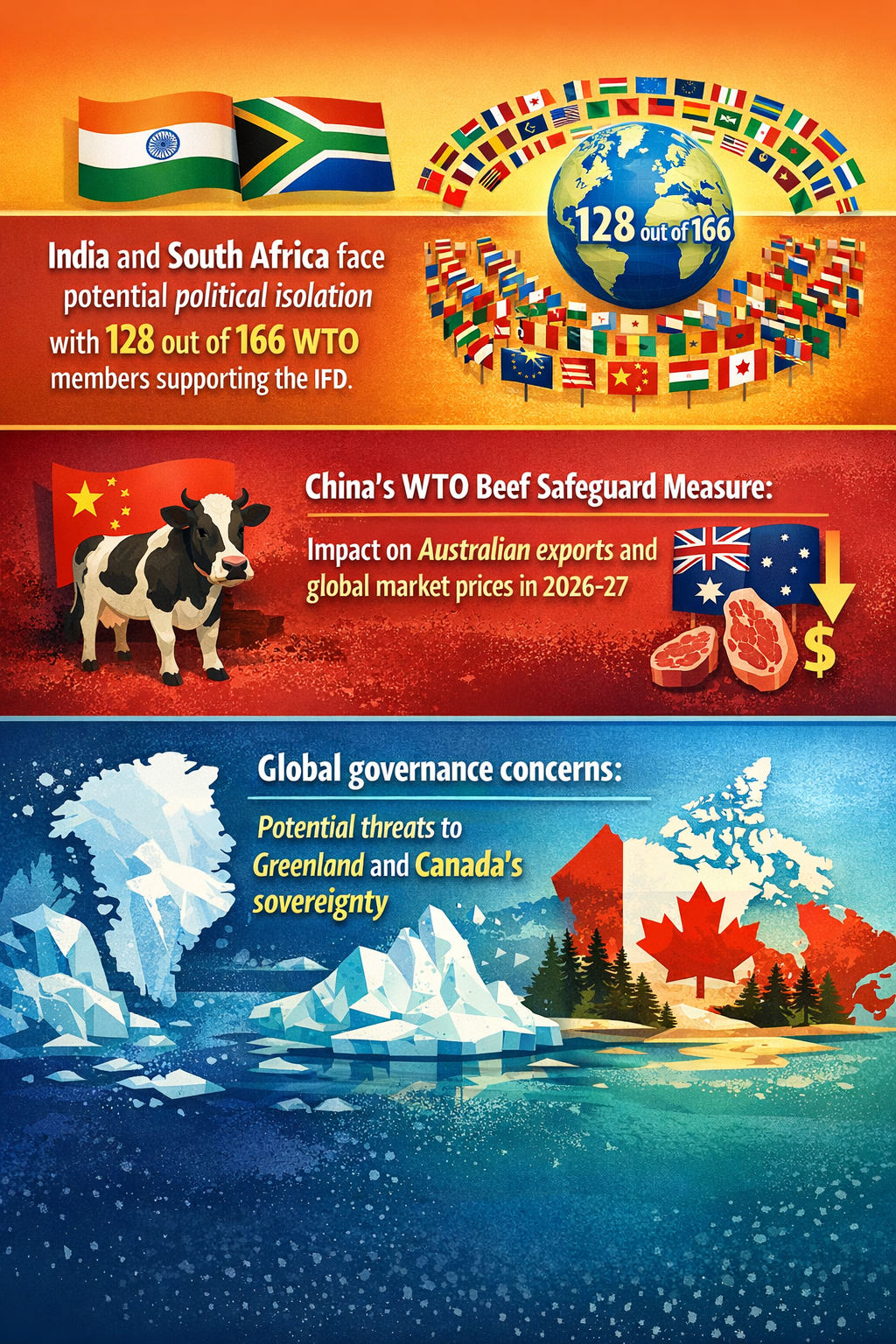
This development qualifies as a wildcard signal: it is a low-visibility but highly consequential factor with uncertain outcomes that could disrupt established international institutional arrangements. The rising political isolation of India and South Africa within the WTO’s current reform trajectory exemplifies a growing discord between developed and developing country blocs, evidenced by their resistance to the International Framework for Development (IFD) backed by 128 out of 166 WTO members (Edurev 23/03/2026).
Time horizon: Medium to long-term (10–20 years); Plausibility band: Medium; Primary sectors exposed: international trade, regulatory policy, capital markets, and industrial strategy. The disruption potential grows as governance legitimacy and institutional compliance norms erode, reshaping global investment climates and trade frameworks.
What Is Changing
The WTO, once viewed as the cornerstone of global trade governance, is visibly strained by divergent member interests and reform deadlocks. The mounting support for plurilateral trade agreements, such as the e-commerce tariff moratorium push led by the U.S. (Los Angeles Times 17/03/2026), contrasts sharply with the reticence of key emerging economies like India, which continues to prefer bilateral deals and resist fundamental WTO reforms (Financial Times 23/03/2026).
These dynamics reveal a fracture in the multilateral paradigm: rather than a unified and adaptive governance body, the WTO increasingly functions as a platform where blocs with conflicting strategies coexist, edging toward fragmentation and political isolation of dissenting countries. The climate-industrial policy clash exemplifies how narrow frameworks undermine policy space and prompt compliance challenges (Policy Alternatives 15/03/2026).
Adding complexity, BRICS countries, led by India and South Africa, signal ambitions to reform global governance through alternative trade arrangements and local currency use, straining WTO consensus and precipitating multipolar governance (Times of India 22/03/2026).
Underlying this systemic friction is also a geopolitical dimension with potential sovereignty anxieties stitched into trade talks and governance—France’s warnings about erosion of global governance norms and territorial disputes reflect broader anxieties about the stability of existing international legal orders (Spacewar.com 18/03/2026).
Disruption Pathway
The political isolation of India and South Africa within WTO reform discussions could accelerate as plurilateral deals proliferate and exclude key emerging markets, forcing them to pursue alternative governance architectures. As they deepen bilateral and regional agreements outside the WTO framework, the institution’s authority and legitimacy may increasingly erode.
This erosion creates compliance pressures and incentivizes states to exploit remaining policy space divergences, especially in climate and industrial policies where WTO constraints are perceived as limiting sovereign action (Policy Alternatives 15/03/2026). In parallel, economic actors face increased uncertainty over regulatory enforcement, trade barriers, and dispute resolution mechanisms, affecting capital allocation and supply chain strategies.
Structural adaptations may include: the formalization of competing trade blocs with divergent regulations and rules; increased demand for alternative dispute resolution frameworks; and financial centers and investors shifting away from jurisdictions tied tightly to existing multilateral rules toward more adaptive regional or bilateral regimes. A reinforcing feedback loop appears as political friction further undermines WTO reforms, emboldening more countries to “opt out” of multilateral commitments.
Ultimately, this process risks fragmenting global economic governance into multiple overlapping and sometimes competing architectures, challenging the dominance of the WTO and traditional regulatory frameworks. This could also incentivize capital flight from markets perceived as politically isolated or subject to inconsistent trade enforcement.
Why This Matters
For senior decision-makers, this scenario implies increasing complexity and risk in cross-border investments, trade compliance, and regulatory strategy. Capital allocation strategies that currently assume a stable, rule-based multilateral trading order may become vulnerable to geopolitical friction and institutional fragmentation. Regulatory frameworks could bifurcate, requiring more nuanced, country- and bloc-specific compliance protocols.
Industrially, companies reliant on global supply chains might face sudden trade barriers or conflicting standards, forcing strategic repositioning or localization. Sovereign risk assessments will need to account for governance fragmentation risks, as political isolation within institutions like the WTO may signal broader geopolitical divergence affecting market access, dispute risk, and operational continuity.
Governments may need to recalibrate diplomatic engagement and investment promotion policies, balancing between plurilateral collaboration and bilateral outreach while managing the risk of isolation in one framework or another.
Implications
This nascent governance fragmentation might plausibly become the defining structural challenge for international trade and capital deployment over the next 10–20 years. It could significantly reshape industrial strategies by encouraging regionalization, digital trade agreements, and localized regulatory innovation.
Conversely, this dynamic is not inevitable; effective multilateral reform driven by inclusive diplomacy or accommodative governance models could stabilize WTO relevance and prevent fragmentation. Likewise, some interpret ongoing bilateralism and plurilateralism as efficient evolution rather than a breakdown of multilateralism.
It is unlikely this development is simple protectionism or transient diplomatic friction; rather, the pattern indicates a systemic inflection with broad implications for global governance architectures.
Early Indicators to Monitor
- Progress and membership shifts in plurilateral agreements outside WTO, notably around digital trade and e-commerce tariff standards
- Public WTO statements by India, South Africa, and other emerging economies expressing reform resistance or alternative alliance formation
- BRICS summit declarations advocating alternative governance frameworks, local currency trade, or parallel institutional arrangements
- New regulatory policies adopted unilaterally by major economies that test WTO compliance boundaries, especially in climate and industrial policy
- Capital flows shifting away from jurisdictions with WTO membership but emerging governance contention
Disconfirming Signals
- Substantive, inclusive WTO reform negotiations culminating in compromise frameworks accepted by India and South Africa
- Declining importance of plurilateral agreements as countries revert to comprehensive multilateral modes
- Reduced political tensions over sovereignty and trade in global forums, accompanied by renewed diplomatic cohesion
- Stabilization or reinforcement of WTO dispute resolution mechanisms with increased compliance
- Evidence that capital markets show no aversion to countries perceived as institutionally isolated
Strategic Questions
- How should capital allocation strategies incorporate the risk of institutional fragmentation across trade and regulatory regimes?
- What governance and compliance adaptations are necessary if WTO authority diminishes in favor of plural or regional economic orders?
Keywords
Multilateral trade governance; WTO reform; Plurilateral agreements; BRICS economic cooperation; Trade fragmentation; Capital allocation risks; Global governance reform; Climate industrial policy
Bibliography
- UPSC Daily Current Affairs: With 128 out of 166 WTO members supporting the IFD, India, along with South Africa, risks facing political isolation. Edurev. Published 23/03/2026.
- U.S. pushes WTO to make e-commerce tariff moratorium permanent. Los Angeles Times. Published 17/03/2026.
- Despite India’s embrace of bilateral dealmaking, diplomats at the World Trade Organization do not expect India to radically alter its approach. Financial Times. Published 23/03/2026.
- World Trade Organization strikes down climate industrial strategy again, risking compliance challenges. Policy Alternatives. Published 15/03/2026.
- The BRICS Summit will see PM Modi engage on governance reform, AI, climate action, and economic cooperation. Times of India. Published 22/03/2026.
- French leader warns global governance is key amid geopolitical anxieties over territorial disputes and alliance trust. Spacewar.com. Published 18/03/2026.