
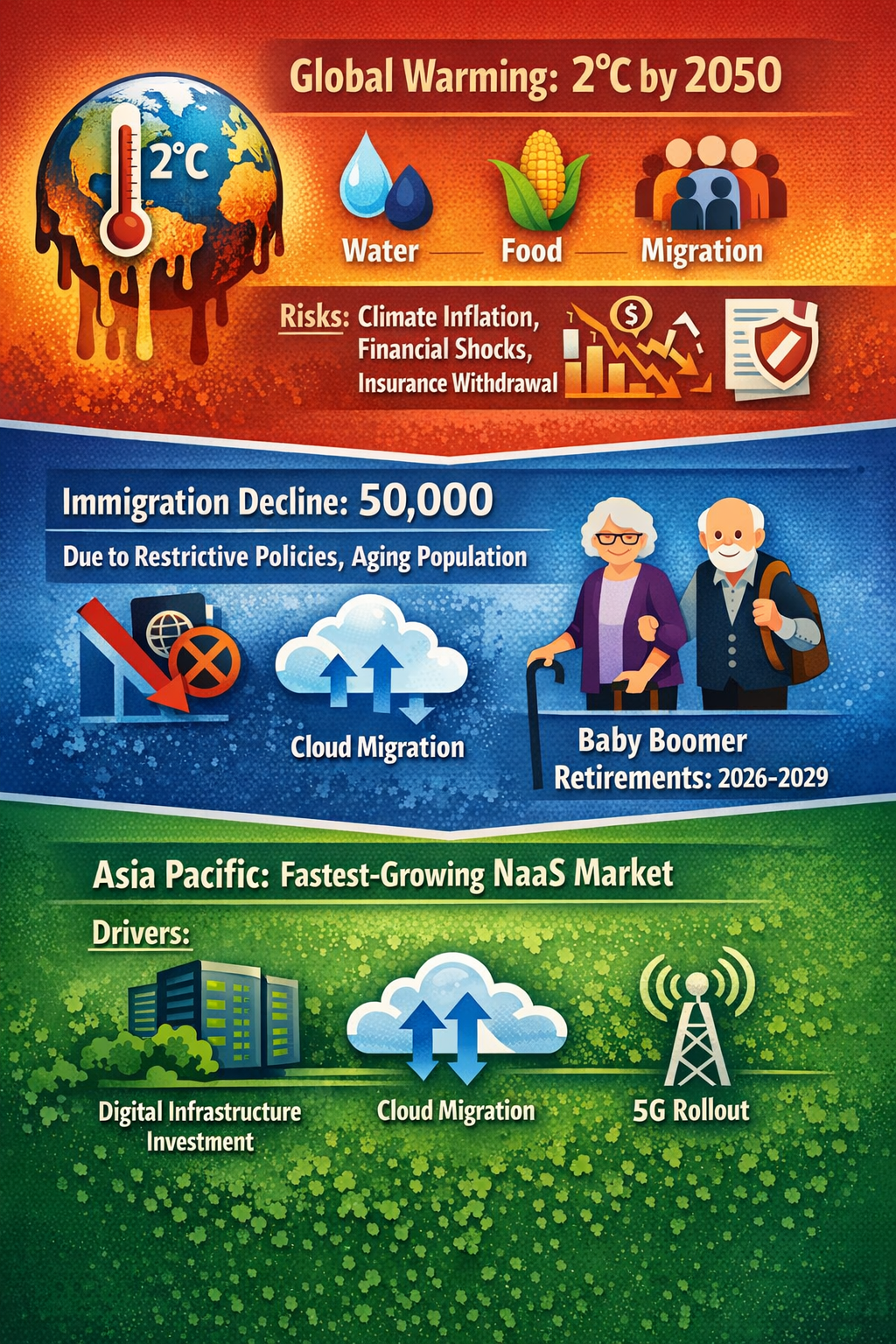
Climate-Induced Geo-Migration as a Geo-Strategic Wildcard Reconfiguring Migration & Mobility Paradigms
Emerging climate migration from vulnerable microstates and the weaponisation of migration flows represent a little-recognised inflection point with potential to reshape migration governance, capital flows, and geopolitical-industrial alignments over the next two decades.
As low-lying nations like Tuvalu face existential climate threats, coupled with states such as Morocco using migration pressure as an asymmetric coercion tool, migration & mobility are entering a phase of disruptive transformation. This paper spotlights the subtle but potent intersection of climate vulnerability and geopolitical instrumentalisation as an underappreciated structural inflection, potentially redefining regional cooperation, global regulatory regimes, and capital investment patterns in migration management and infrastructure. Deeper scrutiny reveals a nexus of climate, security, and regulatory realignments that could shift the industrial structure and regulatory architecture in ways not fully anticipated by mainstream migration discourse.
Signal Identification
This development qualifies as a wildcard intertwined with an emerging inflection indicator. Its wildcard aspect derives from the confluence of environmental vulnerability triggering migration from small island nations, combined with the weaponisation of migration flows by states as geopolitical leverage, a synergy currently under-recognised in migration foresight. The inflection element is the nascent but accelerating trend of migration becoming a coercive strategic instrument, intersecting with climate-driven displacement in fragile geographies.
The estimated time horizon for observable, potentially structural effects spans 10–20 years, with a medium plausibility band given current climate trajectories and recent geopolitical actions. Key sectors exposed include national security and defense, migration policy and border management, regional economic development, supply chain logistics (notably through chokepoints like the Strait of Gibraltar), and international regulatory frameworks related to migration and humanitarian protection.
What Is Changing
Climate migration from vulnerable small island states such as Tuvalu embodies a crystallising pressure on migration patterns and international policy. Tuvalu’s situation highlights an accelerating challenge: rising sea levels and environmental degradation steadily erode habitability, pushing populations toward displacement (Lowy Institute 15/02/2026). Unlike typical migration corridors, climate migration from microstates is a forced exodus with limited relocation options, calling for systemic innovation in international protection and integration frameworks.
Simultaneously, the Ceuta migration crisis underscores migration flows weaponised as a diplomatic and coercive tool by Morocco against Spain and, by extension, European Union member states (CES Intelligence 02/02/2026). This evolution from migration as a humanitarian or economic phenomenon into a lever of statecraft represents a paradigm shift in mobility governance.
Meanwhile, South Africa’s focus on regional cooperation to stabilize migration reflects growing recognition that traditional unilateral border control policies inadequately address the root causes and consequences of migration within interdependent regions (DIRCO 11/02/2026). This signals a structural move towards multilateral governance mechanisms designed for complexity and resilience rather than containment.
Overlaying these dynamics are tightening immigration regulations and salary thresholds in jurisdictions such as the UK, which challenge traditional labour mobility models and may unintentionally incentivize irregular or alternative migration pathways (Mishcon de Reya 09/02/2026). Regulators’ increased focus on eligibility criteria could exacerbate bottlenecks amid rising migration pressures.
Japan’s potential pivot to a more restrictive immigration and security stance under a right-wing coalition also illustrates how migration is becoming a key domestic political fault line influencing international openness and labour market strategies (Mainichi 08/02/2026). This juxtaposes with the expanding imperative for cooperative migration governance.
Collectively, these signals suggest the emergence of a new systemic theme: migration is evolving from a primarily economic and social mobility mechanism to a multi-dimensional strategic domain shaped by climate vulnerability, geopolitical contestation, and shifting regulatory architecture. This systemic shift is under-recognised relative to prevailing migration narratives that frame environmental displacement and migration weaponisation as separate or transient issues.
Disruption Pathway
The escalation of climate displacement pressures from small island states could serve as a trigger for broader regional instability and large-scale cross-border migration, especially if international resettlement mechanisms remain underdeveloped or politically contested. The marginal nature of these states renders international community responses both urgent and complex due to sovereignty, compensation, and rights considerations.
Concurrently, states’ increasing use of migration as geopolitical leverage creates a feedback loop heightening tensions along migration chokepoints. The Ceuta crisis exemplifies how coercive migration inflows can disrupt critical logistics hubs, compelling military and border security recalibrations with cascading effects on supply chains and trade alliances.
These strains are likely to stress existing unilateral migration and border control systems, compelling structural adaptations such as increased investment in regional multilateral frameworks, enhanced climate migration legal regimes, and revised international humanitarian protection models. Industrial sectors linked to border technologies, migration infrastructure, and security logistics may undergo strategic repositioning as state and supranational actors seek agile responses adaptable to fluid migration modalities.
Regulatory regimes may evolve from rigid bilateral visa and sponsorship models to more dynamic, risk-sensitive frameworks incorporating climate risk indices and geopolitical stability factors. This could catalyse innovation in digital identity management and cross-border credentialing, potentially accelerating adoption of emerging systems like post-quantum digital signatures for high-impact identity credentials (Biometric Update 20/06/2026), essential for secure, scalable migration management amid rising complexity.
Such adaptations may unintentionally incentivize new forms of migration inequity or illicit flows if governance models lag technological or geopolitical evolution, potentially destabilising labour markets and social cohesion, especially in destination countries with tightening immigration policies like the UK and Japan. Hence, dominant migration governance models could shift from state-centric gatekeeping toward hybrid, multi-stakeholder architectures that embed climate and geopolitical risk intelligence into their operational design.
Why This Matters
For capital allocators, the convergence of climate migration and migration weaponisation heralds a shift requiring recalibration of risk assessments in infrastructure investments, particularly in logistics hubs vulnerable to disruption (e.g., the Strait of Gibraltar). Investments in border technology, biometric identity solutions, and regional migration cooperation frameworks may accelerate.
Regulators face increasing pressure to harmonise migration, climate, and security policies, demanding cross-sectoral collaboration and potentially new international standards or treaties addressing climate-induced migration and coercive migration flows. Non-aligned or fragmented regulation could exacerbate vulnerabilities or invite geopolitical backlash.
Industrial competitors in migration-enabling technologies (digital identity, border sensors) and logistics providers must anticipate shifts toward more politicised and securitised migration environments coupled with emerging legal frameworks protecting climate-displaced persons. Supply chain resilience planning may need to incorporate migration volatility as a non-traditional systemic risk.
Governments and international bodies may encounter growing liability exposure linked to inadequate protection or mismanagement of climate migrants and those caught in politically weaponised migration flows, affecting reputational capital and diplomatic relations. Early adaptation to these emerging norms and operational realities could confer strategic advantage.
Implications
This composite signal could plausibly scale from current episodic crises into a sustained structural regime that redefines migration as an intersectional challenge at the nexus of climate response, geopolitical strategy, and technological governance. It might prompt reallocation of capital toward climate-resilient migration infrastructure, digital identity innovation, and multilateral regional governance.
Regulatory architectures may evolve beyond national sovereignty paradigms, embedding climate risk and security dimensions into migration law, requiring new international cooperation formats that might challenge existing global governance institutions.
This development should not be interpreted as inevitability; political pushback, technological gaps, or stabilisation of climate conditions could limit expansion. Alternate interpretations might emphasise economic incentives or demographic dynamics as dominant migration drivers, sidelining the geopolitical weaponisation and climate nexus.
Nonetheless, decision-makers ought to incorporate this intertwined climate-geopolitical migration lens to avoid strategic surprise and to seize opportunities in innovating governance, infrastructure, and technology aligned with the emerging migration paradigm.
Early Indicators to Monitor
- Increased diplomatic references to migration as a coercive or strategic tool in bilateral or multilateral forums.
- Formal multilateral initiatives or treaties addressing climate migration protections and regional cooperation protocols.
- Venture funding and patents related to climate-resilient migration infrastructure and secure digital identity systems (notably post-quantum cryptography for identity verification).
- Capital reallocation patterns signaling increased investment in transportation chokepoints and border security technology along politically sensitive migration corridors.
- Domestic regulatory reforms in key migrant-receiving countries tightening or relaxing worker eligibility criteria in response to migration flux.
Disconfirming Signals
- Significant breakthroughs in climate mitigation reducing migration pressure from vulnerable microstates.
- De-escalation of geopolitical tensions involving migration weaponisation incidents or effective multilateral crisis management preventing recurrence.
- Rapid international consensus on comprehensive, rights-based climate migration frameworks reducing fragmentation and impunity.
- Substantive reductions in EU or other regional migration chokepoint vulnerabilities through infrastructural or policy innovation.
Strategic Questions
- How can capital investments be aligned proactively to address the growing intersection of climate risk, migration flows, and geopolitical instability?
- What regulatory innovations could be pursued today to preemptively encompass climate-induced and weaponised migration scenarios while balancing sovereignty and human rights?
Keywords
Climate Migration; Geopolitical Risk; Migration Governance; Digital Identity; Post-Quantum Cryptography; Regional Cooperation; Border Security; Supply Chain Resilience
Bibliography
- Post-quantum digital signatures for high-value and high-impact systems are targeted for 2031, with the remaining migration scheduled for completion by 2035. Biometric Update. Published 20/06/2026.
- As visa sponsorship rules tighten and immigration salary thresholds affect whether individuals can be sponsored to work in the UK, employers face two related risks. Mishcon de Reya. Published 09/02/2026.
- A big win by Takaichi's coalition could mean a significant shift to the right in Japan's security, immigration and other policies, with its right-wing partner JIP's leader Hirofumi Yoshimura saying his party will serve as an accelerator. Mainichi. Published 08/02/2026.
- The Ceuta migration crisis demonstrates that Rabat retains the capacity to weaponise migration flows as a coercive tool against European partners - a risk factor for logistics operations through Spanish enclaves and the Strait of Gibraltar. CES Intelligence. Published 02/02/2026.
- South Africa will emphasise the importance of regional cooperation in addressing migration challenges in a manner that promotes stability, development and respect for human rights. DIRCO. Published 11/02/2026.
- Being small low-lying islands, Tuvalu is affected by a range of climate threats, and prospects of climate migration. Lowy Institute. Published 15/02/2026.